

1. Salesforce Chatter (Tool):
Chatter is a Salesforce real-time collaboration application that lets your users work together, talk to each other, and share information. Chatter connects, engages, and motivates users to work efficiently across the organization, regardless of role or location. Chatter lets users collaborate on sales opportunities, service cases, campaigns, and projects with embedded apps and custom actions.
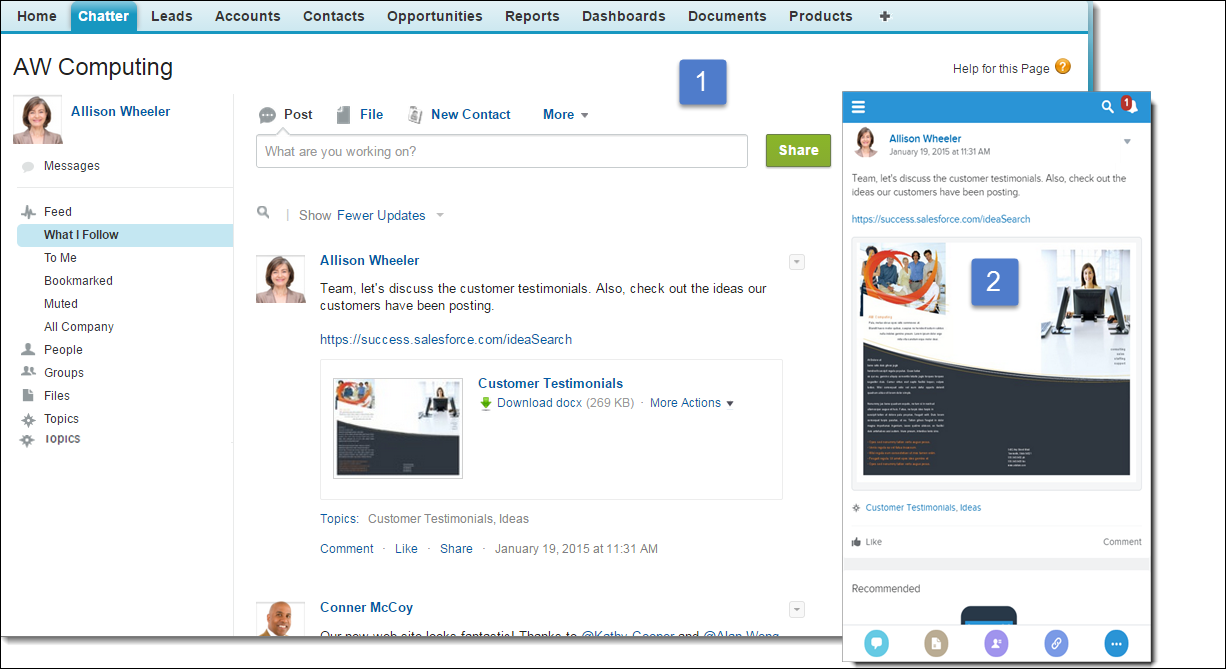
Use Chatter in your favorite browser or on your phone or other mobile device. The Salesforce mobile app offers a rich and powerful mobile interface for collaboration on the go.
2. Salesforce AppExchange:
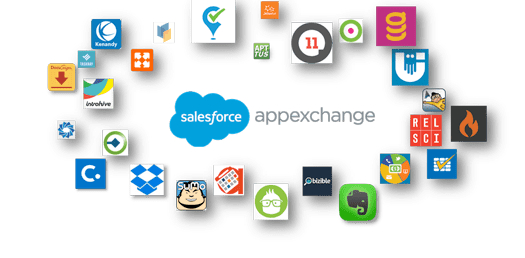
Salesforce AppExchange is Salesforce’s cloud computing store. It’s used by developers and independent software vendor (ISV) partners to sell the apps they’ve built on the Salesforce platform.
Salesforce built AppExchange for enterprise to provide everything from point solutions to full-blown professional automation apps empowering them to achieve measurable business goals in the cloud.
In AppExchange’s huge repository, some apps are free, while many carry a subscription fee. Apps are categorized in three main ways:
- By type (apps, components, Lightning Bolt solutions)
- By product (sales, services, marketing, etc.)
- By industry (government, education, finance, etc.)
Salesforce AppExchange products come in two flavors: Managed packages and unmanaged packages.
3. Online lead or case forms:
A lead is a person or business that expresses interest in purchasing products or services at your company.
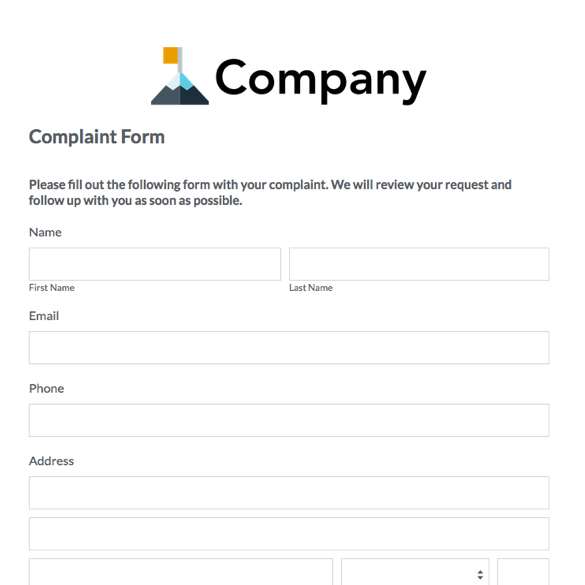
By placing a high-converting lead generation form in a landing page you can generate leads to improve business.
From there, you begin to nurture the leads—persuading them to buy your product. A Salesforce study found that “companies that excel at lead nurturing generate 50 percent more sales-ready leads at 33 percent lower cost.”
The gateway between your site and the visitor is the lead generation form, also known as the lead gen form. As you already know, a lead gen form that’s placed on a landing page with offers visitors can’t resist always performs well.
Setting up these pages manually can be time-consuming for admins and developers. Using custom, drag-and-drop tools like a dedicated Salesforce Web-to-Lead Form Builder or Web-to-Case Form Builder allows you to build and launch high-converting forms in minutes. This ensures clean, structured data flows directly into your CRM without writing a single line of custom code, saving hours of manual setup and debugging.
4. Marinara: Pomodoro Assistant (Chrome Extension):
The Pomodoro Technique is a time management method developed by Francesco Cirillo in the late 1980s. The technique uses a timer to break down work into intervals, traditionally 25 minutes in length, separated by short breaks. Each interval is known as a pomodoro.
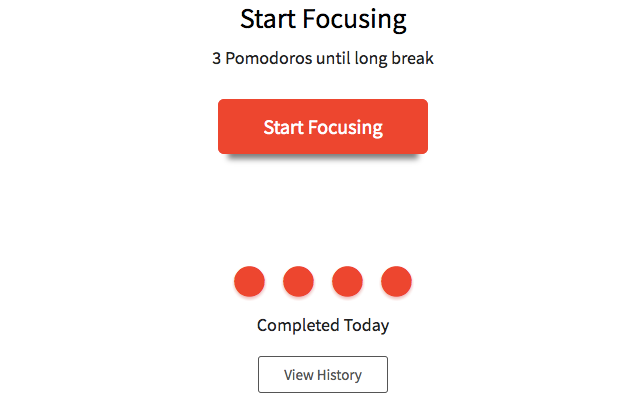
There are six steps in the original technique:
- Decide on the task to be done.
- Set the pomodoro timer (traditionally to 25 minutes).
- Work on the task.
- End work when the timer rings and put a checkmark on a piece of paper.
- If you have fewer than four checkmarks, take a short break (3–5 minutes), then go to step 2.
- After four pomodoros, take a longer break (15–30 minutes), reset your checkmark count to zero, then go to step 1.
Marinara: Pomodoro Assistant is an implementation of this technique in Chrome.
5. Quip (Collaborative Documents)
Quip is a collaboration tool with built-in office suite functionality, including word processing, spreadsheet and presentation software. As a standalone product, it enables teams to collaborate around a rich set of documents. Quip for Salesforce is embedding that kind of functionality at the platform level.

Quip appears as a tab in the Sales or Service Cloud interface. There, employees can collaborate on documents and maintain all of their information in a single place without switching between multiple applications or losing context, an increasingly important goal for collaboration tools, including Slack.
6. Salesforce Experience Cloud & Public Sites
While traditional Force.com Sites are still supported, modern businesses use Salesforce Experience Cloud to build responsive, public-facing portals and websites. By giving customers and partners self-service access to log support cases or view order statuses, you eliminate manual data entry for your internal team, boosting overall organizational efficiency.

Common use cases for public sites include:
Corporate Portals and Intranets
Restricting access by IP or login to share files, templates, and company announcements securely.
Customer Support Microsites
Providing dynamic forms for registration, payment processing, or service requests.
Product Catalogs & Store Locators
Pushing real-time Salesforce data to a public site for external visitors.
7. Salesforce Inspector (Chrome Extension)
If you are an administrator, developer, or power user, you spend a lot of time looking up field API names, checking record details, or exporting data. The Salesforce Inspector extension (and its newer version, Salesforce Inspector Reloaded) is a must-have for improving Salesforce productivity.
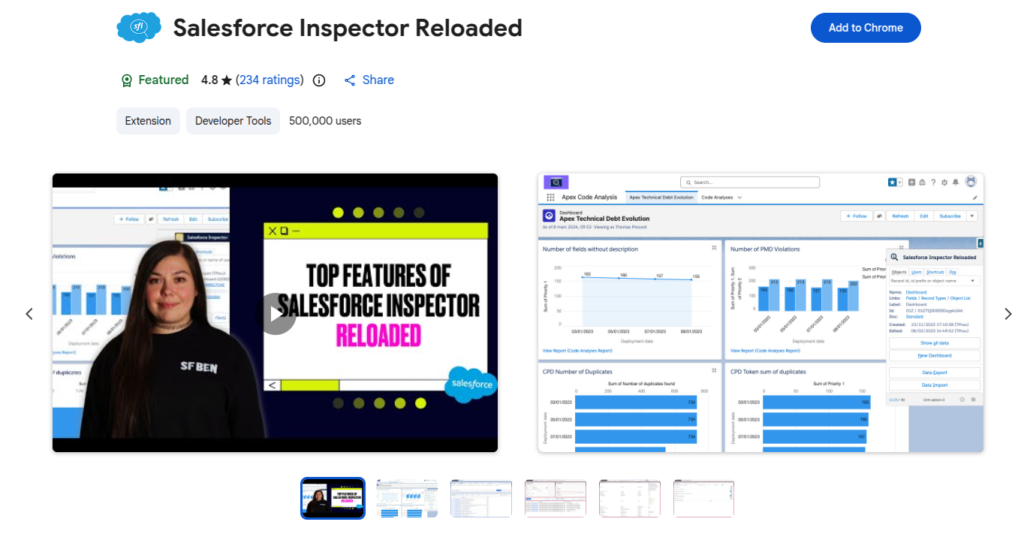
With a small, unobtrusive sidebar overlay on your browser, this tool lets you:
Inspect Field Data
View all field values for a record instantly, even if they are not on your current page layout.
Quick Data Import/Export
Run queries and export data to Excel or import bulk updates without launching the heavy desktop Data Loader.
View System Limits
Access org limits, user profiles, and metadata details in a single click.
8. Salesforce Lightning Split View and Kanban
Salesforce Lightning includes built-in layout options designed to streamline your daily navigation. If you are only working out of standard list views, you are missing out on major productivity gains:
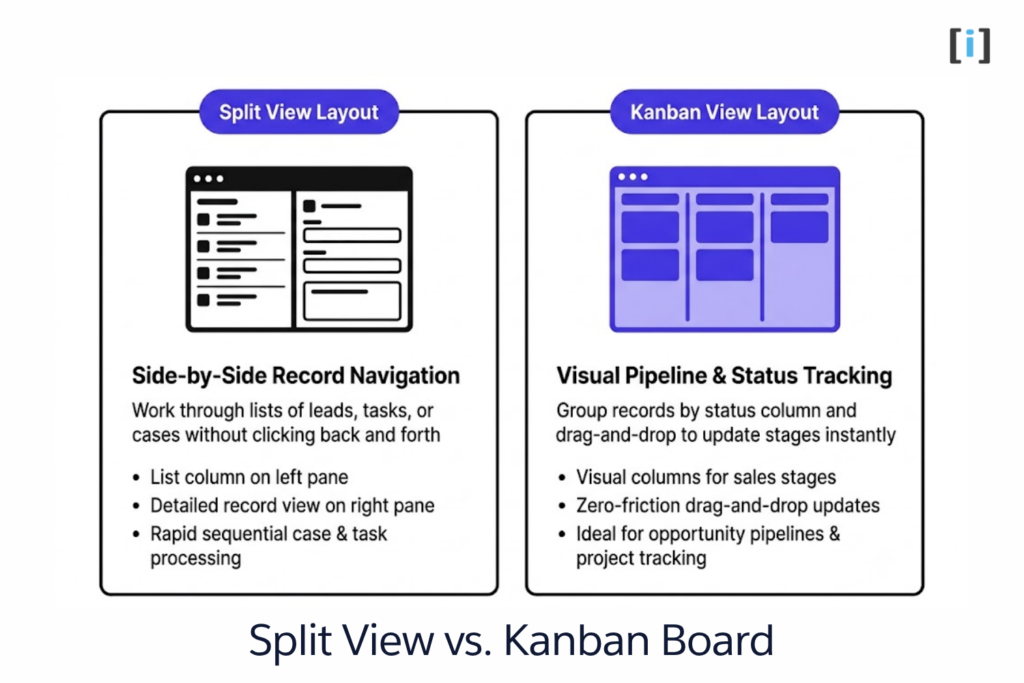
Split View
This layout displays your list of records on the left side of the screen while keeping the detailed view of the selected record open on the right. It allows you to work through a list of leads, tasks, or cases without having to continuously click back and forth.
Kanban View
Perfect for sales pipelines and project tracking, this visual board groups records by status columns. You can drag and drop records from one column to another to update their status instantly, keeping your pipeline accurate with zero friction.
FAQs
How can I increase user productivity in Salesforce?
To boost user efficiency, focus on minimizing clicks and screen switching. You can do this by clean page layout design, teaching built-in Lightning features like Split View and Kanban boards, and using browser extensions like Salesforce Inspector for instant data and metadata access.
What are the best Salesforce productivity extensions for Chrome?
The top-recommended Chrome extensions include:
Salesforce Inspector (or Inspector Reloaded): Essential for administrators and developers to inspect field values, query metadata, and import/export data.
Organizer for Salesforce: Great for managing multiple Salesforce logins, org tabs, and colors.
Marinara: Pomodoro Assistant: Perfect for structured time management and keeping users focused on their tasks.
How does Salesforce automation improve business productivity?
By automating repetitive, low-value manual tasks. Using Salesforce Flows and automated Web-to-Lead or Web-to-Case form builders, customer data enters your CRM instantly and cleanly without any manual typing. This frees up your sales and service teams to focus on actual customer engagement.
Is Chatter still useful for team collaboration in Salesforce?
Yes, Chatter is excellent for keeping team discussions tied directly to specific records (such as an active opportunity or support ticket). However, if your team uses Slack, integrating it with Salesforce allows you to send automated alerts, update records, and coordinate between departments without leaving your primary workspace.
How does Salesforce Experience Cloud improve service team efficiency?
It allows you to build secure, public-facing self-service portals. Instead of your customer service team manually logging cases or checking order statuses, customers can log in to do it themselves. This reduces your support ticket volume, allowing your agents to handle more complex cases faster.