
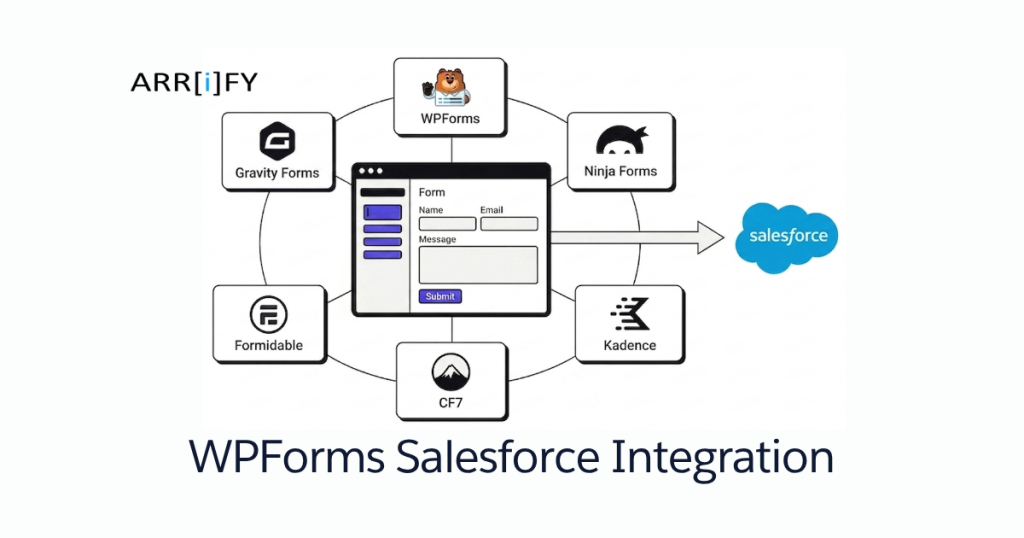
You’ve got a WordPress site and Salesforce. Someone fills out a contact form. That lead should land in Salesforce instantly — right person, right object, no copy-paste.
The problem isn’t the concept. It’s picking the right form plugin. Not every WordPress form builder plays nicely with Salesforce, and the ones that do vary a lot in how deep the integration goes, what it costs, and how much setup it actually takes.
This post covers six WordPress forms compatible with Salesforce — WPForms, Gravity Forms, Ninja Forms, Formidable Forms, Contact Form 7, and Kadence — with an honest look at what each one does well and where it falls short.
What makes a WordPress form compatible with Salesforce?
Not all form plugins that “support Salesforce” do the same thing. Before picking one, it’s worth understanding what the connection actually needs to do.
At minimum, you need:
- Field mapping — each form field (name, email, phone) maps to a Salesforce field on the correct object (Lead, Contact, Account, etc.)
- Object selection — the plugin needs to let you choose which Salesforce object a submission creates or updates. Salesforce has three common targets for web forms: Web to Lead, Web to Case, and custom objects — it’s worth knowing which one you need before you build the form.
- Authentication — a direct OAuth connection to your Salesforce org, or a pass-through via Zapier/Make
Nice-to-haves that matter for real use:
- Conditional routing — send a submission to different Salesforce objects based on what the user selected
- Custom field support — map to fields you’ve added to Salesforce, not just standard ones
- Duplicate handling — update an existing Contact instead of creating a duplicate Lead
Key Takeaway: A plugin that only connects via Zapier isn’t really a “Salesforce-compatible” form — it’s a form that works with Zapier, which then works with Salesforce. That adds cost, latency, and a dependency. Native connections are always better when available.
Gravity Forms Salesforce integration
Gravity Forms is the most powerful WordPress form builder for Salesforce, and the one most commonly recommended when the integration needs to handle real complexity. It has a native Salesforce for Gravity Forms add-on that connects via OAuth — no Zapier required.
What it does:
- Creates and updates Leads, Contacts, Opportunities, and custom objects
- Full field mapping including custom Salesforce fields
- Conditional logic for routing submissions to different objects based on form values
- Supports multi-step forms, file uploads, and calculated fields that map through to Salesforce
The catch: Gravity Forms itself is paid (~$59–$259/year depending on tier), and the Salesforce add-on requires the Elite license (~$259/year). It’s the most capable option but also the highest entry cost.
Best for: Complex lead capture, multi-step applications, or any workflow where you need fine-grained control over what gets written to Salesforce and when.
For the full step-by-step setup guide, see How to Connect Gravity Forms to Salesforce. If you need dynamic, conditional forms that adapt based on Salesforce data, see using Gravity Forms for dynamic Salesforce forms.
WPForms Salesforce integration
WPForms has the most polished native Salesforce integration of any WordPress form builder. The Salesforce add-on connects directly to your org via OAuth — no Zapier required.
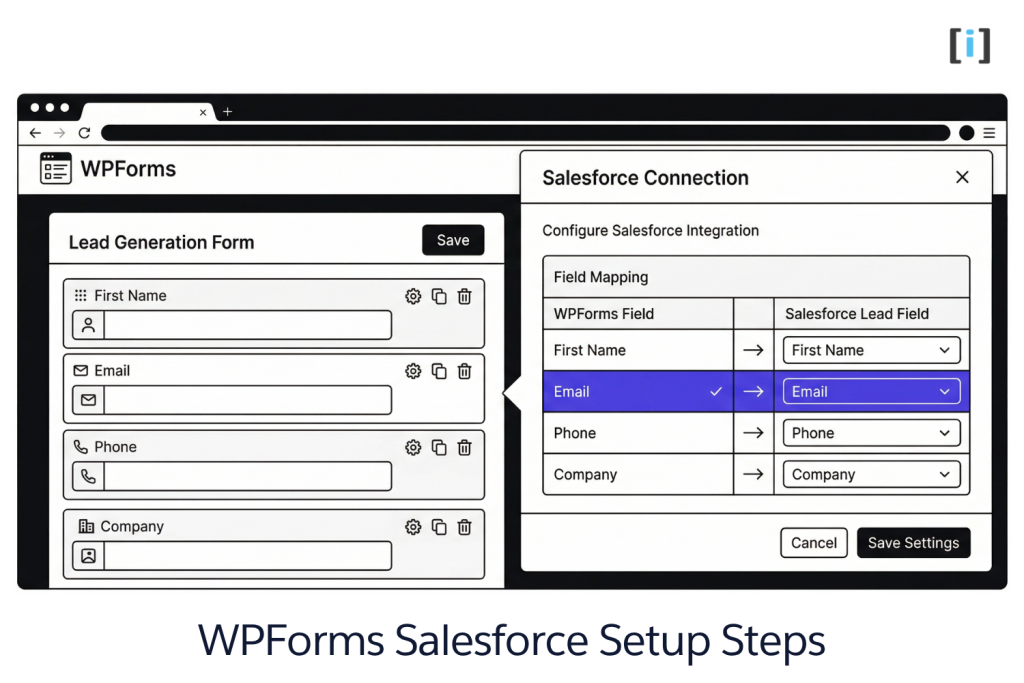
What it does:
- Creates Leads, Contacts, or custom objects from form submissions
- Maps standard and custom Salesforce fields from inside the WPForms form builder
- Supports conditional logic for routing submissions to different Salesforce objects based on form input
- Handles multiple Salesforce connections on a single form
The catch: The Salesforce add-on is only available on the Elite plan (~$299/year). That’s a real cost barrier if Salesforce integration is your only reason to upgrade.
Best for: Teams already on WPForms Elite, or who want the most turnkey setup with the least troubleshooting.
Ninja Forms Salesforce integration
Ninja Forms takes a modular approach — the core plugin is free, and you add the Salesforce CRM extension separately (~$99/year for the add-on, or bundled with higher-tier plans).
What it does:
- Direct API connection to Salesforce (no Zapier)
- Creates Leads or Contacts from submissions
- Maps form fields to standard Salesforce fields
- Supports conditional actions — useful if you want Salesforce submission to trigger only when certain fields are filled
Where it falls short: Custom object support is limited compared to WPForms. If you need to write to non-standard Salesforce objects, you may run into walls.
Real Talk: Ninja Forms’ UI has gotten better but it’s still not as intuitive as WPForms for non-developers. Budget an extra hour of setup time the first time you configure a Salesforce connection.
Best for: Users who already use Ninja Forms and don’t want to switch, or who prefer the modular pricing model.
Formidable Forms Salesforce integration
Formidable is the right choice when your forms are doing something more complex than a basic contact or lead form — multi-step forms, calculation fields, conditional sections, or post-submission data manipulation.
What it does:
- Native Salesforce add-on with field mapping to Leads, Contacts, and custom objects
- Supports complex forms with calculated fields, repeating fields, and conditional logic
- Can update existing Salesforce records (not just create new ones)
- POST-submission actions allow chaining: create a Lead, then trigger a follow-up task
The catch: Like WPForms, the Salesforce integration requires a paid plan (Elite, ~$299/year).
Key Takeaway: If your form is basically a contact form, Formidable is overkill. If you’re building something more like a quote calculator or multi-step intake form that needs to map to Salesforce, it’s the strongest option here.
Best for: Complex forms — applications, quotes, intake forms — where data needs to flow into Salesforce accurately with minimal manual cleanup.
Contact Form 7 Salesforce integration
CF7 doesn’t have a native Salesforce add-on from the plugin developers. But there’s a third-party plugin — CF7 Salesforce (by CRM Perks) — that adds a direct Salesforce connection.
What it does:
- OAuth connection to Salesforce
- Maps CF7 form fields to Leads, Contacts, Accounts, or custom objects
- Free version available (with limits); Pro version unlocks custom objects and conditional routing
The honest picture: CF7 is free, and if you’re already using it for simple contact forms, the CRM Perks add-on is the lowest-cost path to Salesforce integration. But the setup is more manual than WPForms or Formidable, and you’re depending on a third-party developer for ongoing compatibility.
The Litmus Test: Are you using CF7 because you already have it on the site, or because you actively chose it? If it’s the former and you’re setting up a new Salesforce integration from scratch, you’ll spend less time with WPForms.
Best for: Sites already running CF7 that need basic lead capture into Salesforce without paying for a premium form builder.
Kadence Forms and Salesforce
Kadence is a block-based form builder (part of the Kadence Blocks suite) that’s gained real traction with WordPress sites using block-first page builders. Its Salesforce integration is newer but functional.
What it does:
- Direct Salesforce connection via the Kadence Conversions or Kadence Blocks Pro add-on
- Maps fields to Salesforce Leads and Contacts
- Fits naturally into Gutenberg/block-based workflows without a separate form plugin
The context: If you’re building a site entirely with Kadence blocks and don’t want to add another plugin ecosystem (WPForms, Gravity Forms, etc.), this keeps your stack leaner.
Real Talk: Kadence’s Salesforce connection is solid for standard use cases but not as mature as WPForms or Formidable. If you hit edge cases with custom objects or complex field mapping, the documentation is thinner.
Best for: Kadence-based sites that want to keep the plugin count low and don’t need advanced Salesforce mapping logic.
Quick comparison: which plugin should you use?
| Plugin | Native Salesforce? | Custom Objects? | Complexity Ceiling | Starting Cost |
|---|---|---|---|---|
| Gravity Forms | Yes (OAuth) | Yes | Very High | Elite ~$259/yr |
| WPForms | Yes (OAuth) | Yes | Medium | Elite ~$299/yr |
| Ninja Forms | Yes (OAuth) | Limited | Medium | Add-on ~$99/yr |
| Formidable Forms | Yes (OAuth) | Yes | High | Elite ~$299/yr |
| Contact Form 7 | Via CRM Perks | Yes (Pro) | Low-Medium | Free / Pro ~$49/yr |
| Kadence | Yes (Pro add-on) | Limited | Low-Medium | Kadence Pro bundle |
Short version:
- Most powerful / complex workflows → Gravity Forms
- Simple contact/lead forms, easiest setup → WPForms or CF7 + CRM Perks
- Complex multi-step forms → Formidable Forms
- Already on Ninja Forms → stay, add the Salesforce add-on
- Block-based Kadence site → Kadence Pro
Key Takeaway: There’s no universally “best” plugin. The right one depends on what you already have installed, how complex your forms are, and whether you want native Salesforce auth or are okay with a third-party add-on.
How to set up the connection: what to expect
Regardless of which plugin you choose, the setup process follows the same pattern:
- Install the plugin and the Salesforce add-on (they’re almost always separate)
- Authenticate with Salesforce — you’ll need admin access to your Salesforce org to authorize the OAuth connection
- Create or open a form
- Add a Salesforce connection from the form’s marketing or integrations settings
- Select the target object — Lead is the most common starting point. If you’re unsure whether to use Lead, Contact, or a custom object, see Salesforce web form types explained. For Lead specifically, see how Web to Lead works in Salesforce — or if you’re embedding the native Salesforce form in WordPress, see our Salesforce Web-to-Lead on WordPress guide.
- Map your fields — match form fields to Salesforce fields one by one
- Set conditions (optional) — only send to Salesforce when a specific field has a certain value
- Test with a real submission — check Salesforce immediately to verify the record
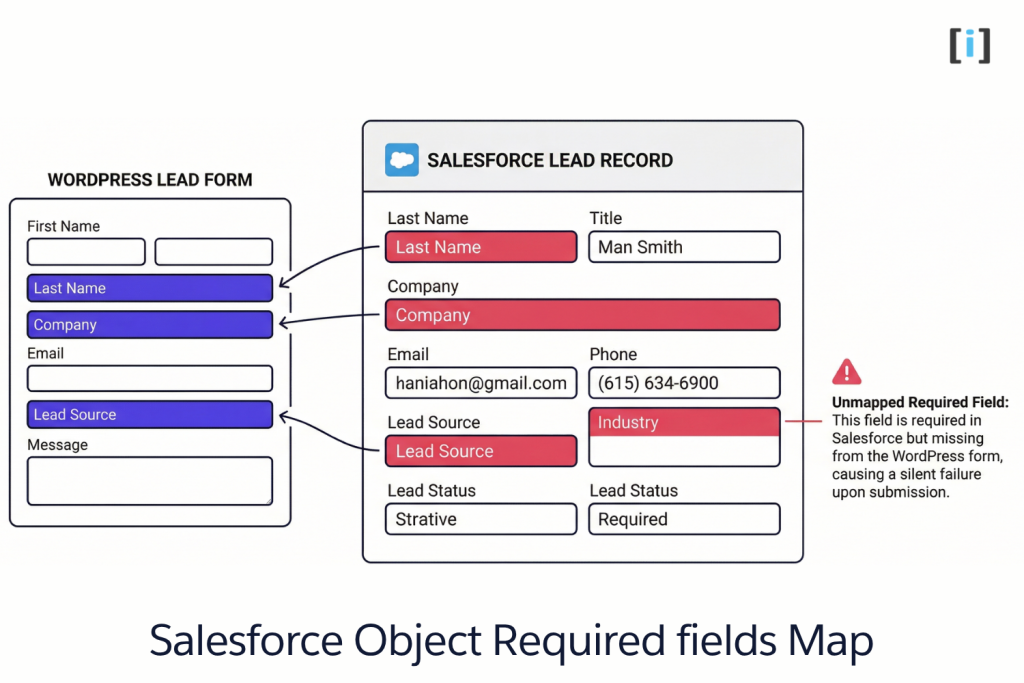
One thing that trips people up: Salesforce required fields. If your Salesforce org has required fields on Lead (common ones: Company, Last Name), your form must collect and map those fields or the submission will fail silently. Check your Salesforce Lead layout before building the form.
Pro Tip: If you’re getting failed submissions that don’t show errors in WordPress, check the Salesforce debug logs (Setup → Debug Logs) — they’ll tell you exactly what field validation is rejecting.
If you need a deeper integration — writing to multiple objects on a single submission, syncing data back from Salesforce to WordPress, or building a custom flow — that’s outside what any plugin handles natively. That’s a custom integration. We build those at Arrify.
For a full overview of integration approaches (forms being one of several), see WordPress Salesforce integration methods. If you need to sync non-form data — WooCommerce orders, user records, membership data — see WordPress to Salesforce plugins beyond form builders. For the broadest view of every Salesforce form method — native, third-party, and WordPress — see our Salesforce Form Options overview.
FAQs
Do I need Zapier to connect WordPress forms to Salesforce?
No. WPForms (Elite), Ninja Forms (with add-on), Formidable Forms (Elite), CF7 (with CRM Perks), and Kadence (Pro) all connect directly to Salesforce via OAuth. Zapier works too but adds cost and a dependency.
Which WordPress form plugin has the best Salesforce integration?
WPForms has the most polished and documented native Salesforce connection. Formidable Forms is better if your forms are complex. For simple sites already running CF7, the CRM Perks add-on is the lowest-cost path.
Can I connect WordPress forms to Salesforce without a paid plugin?
The CF7 + CRM Perks combination has a free tier that covers basic lead creation. For anything beyond simple field mapping (custom objects, conditional routing), you’ll need a paid plan.
What Salesforce objects can WordPress forms create?
Most plugins support Leads and Contacts out of the box. Custom objects typically require a paid plan (WPForms Elite, Formidable Elite, CF7 CRM Perks Pro). Opportunities and Cases are less commonly supported natively.
What if my form submissions aren’t showing up in Salesforce?
Check three things: (1) your Salesforce required fields are mapped in the form, (2) the OAuth connection hasn’t expired (re-authenticate if needed), (3) Salesforce debug logs for field validation errors.