How to Choose a WordPress Salesforce Plugin
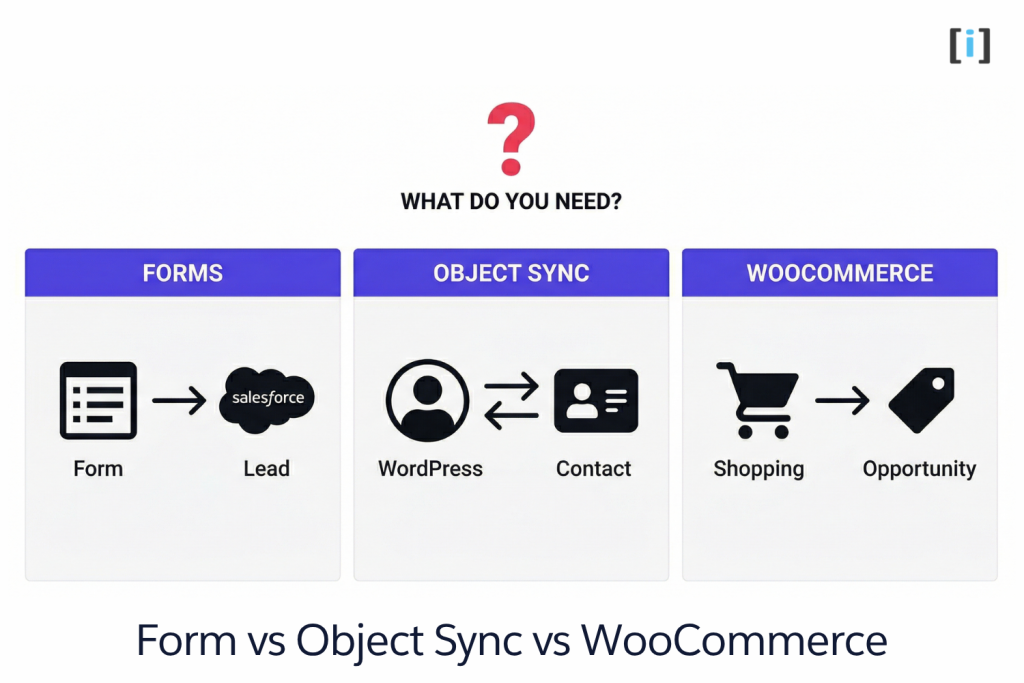
Before comparing individual plugins, figure out what you actually need. The WordPress Salesforce plugin market breaks into four categories, and picking from the wrong one wastes time and money.
Form submission plugins capture data when someone fills out a form on your site and push it to Salesforce as a Lead, Contact, or custom object. If your only goal is lead capture, start here.
Object sync plugins go deeper — they map WordPress objects (users, posts, custom post types) to Salesforce objects and keep them in sync. Some support bi-directional sync. If you’re building a customer portal or membership site, this is your category.
WooCommerce connectors map orders, customers, and product data to Salesforce. If you’re running an online store and want your sales team to see order history in Salesforce, you need a dedicated connector.
Marketing automation plugins connect to Pardot (now Account Engagement) or broader marketing tools. If you’re running Pardot campaigns and need tracking codes or form embeds on WordPress, this is where to look.
The Litmus Test: Ask yourself — “Do I need to push form data, sync objects, map orders, or track marketing?” Your answer narrows the list from 8 plugins to 2-3.
Form-Based Plugins: Push Submissions to Salesforce
These plugins capture form data on your WordPress site and send it to Salesforce. They don’t sync ongoing data — they fire on submission and push records.
WP Gravity Forms Salesforce
Plugin: WP Gravity Forms Salesforce by CRM Perks Rating: 4.9/5 (134 reviews) | Active installs: 4,000+
The most popular WordPress Salesforce plugin for form-based integration. It connects Gravity Forms entries to Salesforce using the REST API, giving you field-level mapping to any standard or custom object.
What it does well:
- Maps form fields to Leads, Contacts, Accounts, Opportunities, Cases, and custom objects
- Supports conditional feed logic — route submissions to different objects based on form answers
- Upsert support (update existing records instead of creating duplicates)
- Multiple feeds per form — one submission can create records across several objects
- Error logging with detailed API response tracking
Where it falls short:
- Requires Gravity Forms Elite license ($259/yr) for the official Salesforce add-on
- One-way sync only (WordPress to Salesforce)
- No bi-directional sync or real-time updates from Salesforce back to WordPress
- Complex multi-object relationships (Account → Contact → Opportunity chain) may need custom middleware
Who it’s for: Businesses already using Gravity Forms that need reliable, flexible form-to-Salesforce mapping with conditional logic and custom object support.
Pro Tip: Gravity Forms Salesforce is trending — search volume for “gravity forms salesforce” jumped 900% in the last 3 months. If you’re evaluating form plugins specifically for Salesforce integration, this is the most battle-tested option.
Learn more: How to Connect Gravity Forms to Salesforce.
Integration for Contact Form 7 and Salesforce
Plugin: CF7 Salesforce Integration by CRM Perks Rating: 5/5 (60 reviews) | Active installs: 4,000+
A multi-form-builder Salesforce connector from CRM Perks. Despite the name, it supports Contact Form 7, WPForms, Elementor Forms, Ninja Forms, Formidable Forms, and more.
What it does well:
- Works with 6+ form builders — not locked to one plugin
- Maps to any Salesforce object (standard and custom)
- Free version covers basic field mapping
- Lightweight — no heavy overhead on your site
Where it falls short:
- Pro version ($69/yr) needed for conditional logic and advanced mapping
- One-way sync only
- No file upload support to Salesforce
- Less granular error logging than the Gravity Forms add-on
Who it’s for: Sites using Contact Form 7, WPForms, or Ninja Forms that want Salesforce lead capture without switching form builders.
Learn more: WordPress Forms Compatible with Salesforce.
Object Sync Plugins: Two-Way Data Synchronization
These plugins go beyond form submissions. They map WordPress data structures (users, posts, custom post types) to Salesforce objects and keep them synchronized.
Object Sync for Salesforce
Plugin: Object Sync for Salesforce by MinnPost Rating: 5/5 (13 reviews) | Active installs: 700+
A free, open-source WordPress Salesforce plugin that provides deep bi-directional sync between WordPress and Salesforce objects. Built by the non-profit MinnPost, it’s community-maintained and developer-friendly.
What it does well:
- True bi-directional sync — changes in WordPress update Salesforce and vice versa
- Maps users, posts, pages, comments, and custom post types to any Salesforce object
- Customizable field mapping with a visual interface
- Configurable sync intervals and conflict resolution
- Completely free — no premium tier
Where it falls short:
- Smaller community and slower update cycle than commercial plugins
- No built-in form integration — you’ll need a separate form plugin
- Setup requires some technical comfort (API credentials, object mapping)
- No dedicated WooCommerce support
- Limited documentation compared to premium alternatives
Who it’s for: Developers and technical teams at non-profits or SMBs who need full object sync without paying for a premium plugin. Ideal for customer portals, membership sites, or any use case where Salesforce and WordPress data must stay in sync.
Key Takeaway: Object Sync for Salesforce is the only fully free, bi-directional sync plugin on this list. If budget is tight and you have some technical ability, start here.
miniOrange Object Data Sync for Salesforce
Plugin: Object Data Sync for Salesforce by miniOrange Rating: 4.9/5 (21 reviews) | Active installs: 200+
The most feature-rich WordPress Salesforce plugin on this list. miniOrange offers bi-directional sync, form integrations, WooCommerce support, and scheduled automation — all from a single plugin.
What it does well:
- True bi-directional sync with real-time updates from Salesforce to WordPress
- Supports form builders (Gravity Forms, CF7, Ninja Forms, WPForms)
- WooCommerce order sync (legacy + HPOS support) in Enterprise tier
- One-time bulk data pull from Salesforce
- Scheduled sync with configurable frequency
- Advanced secondary lookup — match records by any WordPress field
- File/attachment sync from forms to Salesforce records
- Pardot (Account Engagement) integration in Standard tier and above
Where it falls short:
- Starts at $149/yr — not cheap for small sites
- Enterprise tier ($349/yr) required for WooCommerce and scheduled sync
- Smaller user base means fewer community resources and tutorials
- Can be complex to configure for non-technical users
Pricing tiers:
| Plan | Price | Key Features |
|---|---|---|
| Standard | $149/yr | Form integrations, Pardot, real-time sync, one-time pull |
| Premium | $249/yr | + Custom post types, bulk push, attachment sync |
| Enterprise | $349/yr | + WooCommerce, scheduled sync, advanced filtering |
Who it’s for: Businesses that need a single plugin to handle forms, object sync, and WooCommerce — especially those with complex Salesforce architectures using custom objects and relationships.
Real Talk: miniOrange tries to be everything. If you only need form submission capture, it’s overkill. But if you need bi-directional sync AND form integration AND WooCommerce, it’s the only plugin that does all three without stacking multiple tools.
WooCommerce Salesforce Plugins
If you’re running an online store on WooCommerce and using Salesforce for CRM, you need your order data flowing into Salesforce automatically.
WordPress WooCommerce Salesforce Connector
Plugin: WooCommerce Salesforce Connector Active installs: 100+
A dedicated connector for syncing WooCommerce store data with Salesforce. It provides auto-sync functionality for both B2B and B2C use cases.
What it does well:
- Real-time synchronization of orders and customers
- Bi-directional sync capabilities
- Manual field mapping for custom data structures
- Built specifically for WooCommerce — not a generic plugin with WooCommerce bolted on
Where it falls short:
- Smaller active install base — less community validation
- Limited documentation and tutorials
- May not support the latest WooCommerce HPOS (High-Performance Order Storage)
Who it’s for: WooCommerce stores that need a lightweight, dedicated Salesforce connector without the complexity of a full object sync plugin.
Integration for WooCommerce and Salesforce (CRM Perks)
Plugin: WooCommerce Salesforce by CRM Perks Rating: 4.9/5 (45 reviews) | Active installs: 1,000+
From the same team behind the Gravity Forms and CF7 Salesforce plugins. This one maps WooCommerce orders directly to Salesforce objects.
What it does well:
- Maps orders to Opportunities, customers to Contacts/Accounts
- Consistent UI with other CRM Perks plugins (familiar if you use their form plugins)
- Supports custom field mapping
- Free version available with basic mapping
Where it falls short:
- One-way sync (WooCommerce → Salesforce)
- Pro features ($69/yr) needed for conditional logic and advanced mapping
- No inventory or product catalog sync
Who it’s for: WooCommerce stores already using CRM Perks form plugins that want a consistent ecosystem for Salesforce integration.
Marketing Automation: Pardot and WP Fusion
These plugins focus on marketing — visitor tracking, content personalization, and CRM-based access control.
Account Engagement (Pardot) Plugin
Plugin: Account Engagement by Cliff Seal Rating: 2.7/5 (14 reviews) | Active installs: 3,000+
The official WordPress plugin for Salesforce Account Engagement (formerly Pardot). It embeds Pardot forms and dynamic content directly into WordPress pages and adds visitor tracking.
What it does well:
- Embeds Pardot forms and dynamic content with shortcodes
- Adds Pardot tracking code to your WordPress site
- Tracks page views, conversions, and visitor behavior
- Connects campaign data back to Salesforce
Where it falls short:
- Low ratings — users report bugs and compatibility issues with recent WordPress versions
- No form builder — you’re embedding Pardot’s forms, not creating WordPress-native forms
- Limited to Pardot users (requires an Account Engagement subscription)
- Doesn’t sync WordPress data to Salesforce — it puts Pardot content into WordPress
Who it’s for: Teams already paying for Salesforce Account Engagement (Pardot) who need to embed Pardot forms and tracking on their WordPress site. Not for general Salesforce integration.
Real Talk: The Pardot plugin’s rating has been declining. If you’re doing serious Pardot-WordPress integration, consider using Pardot’s form handlers with a WordPress form plugin (like Gravity Forms) instead of this plugin directly.
WP Fusion Lite
Plugin: WP Fusion Lite Active installs: 5,000+
WP Fusion takes a different approach — instead of pushing form data, it syncs WordPress users with CRM contacts and uses CRM tags to control site access. It supports Salesforce along with 50+ other CRMs.
What it does well:
- Syncs WordPress user profiles with Salesforce Contacts
- Restricts content access based on Salesforce/CRM tags
- Works with LMS plugins, membership plugins, and WooCommerce
- Supports 50+ CRMs — good if you might switch from Salesforce later
Where it falls short:
- Lite version is limited — Pro ($247/yr) needed for most useful features
- Jack-of-all-trades — Salesforce support isn’t as deep as dedicated plugins
- Not a form plugin — you still need a form builder for lead capture
- Overkill if you just need to push form submissions
Who it’s for: Membership sites, LMS platforms, or content-restricted sites that need user-level CRM sync and tag-based access control.
Plugin Pricing Breakdown
| Plugin | Free Version | Pro/Premium | What Pro Unlocks |
|---|---|---|---|
| WP Gravity Forms Salesforce | Basic mapping | $259/yr (GF Elite) | Salesforce add-on access |
| CF7 Salesforce (CRM Perks) | Basic mapping | $69/yr | Conditional logic, advanced mapping |
| Object Sync for Salesforce | Full features | N/A (free) | — |
| miniOrange Object Data Sync | Limited | $149–$349/yr | Bi-directional, WooCommerce, scheduled sync |
| WooCommerce Salesforce Connector | Yes | Pro tier | Advanced mapping |
| WooCommerce SF (CRM Perks) | Basic mapping | $69/yr | Conditional logic, advanced mapping |
| Account Engagement (Pardot) | Full features | N/A (free) | — (requires Pardot subscription) |
| WP Fusion Lite | Limited | $247/yr | Deep CRM sync, content restriction |
Key Takeaway: Free options exist for every category. But “free” often means basic field mapping with no error logging, no conditional logic, and no custom object support. Budget $70–$350/yr for a production-ready WordPress Salesforce plugin, depending on your needs.
When a Plugin Isn’t Enough
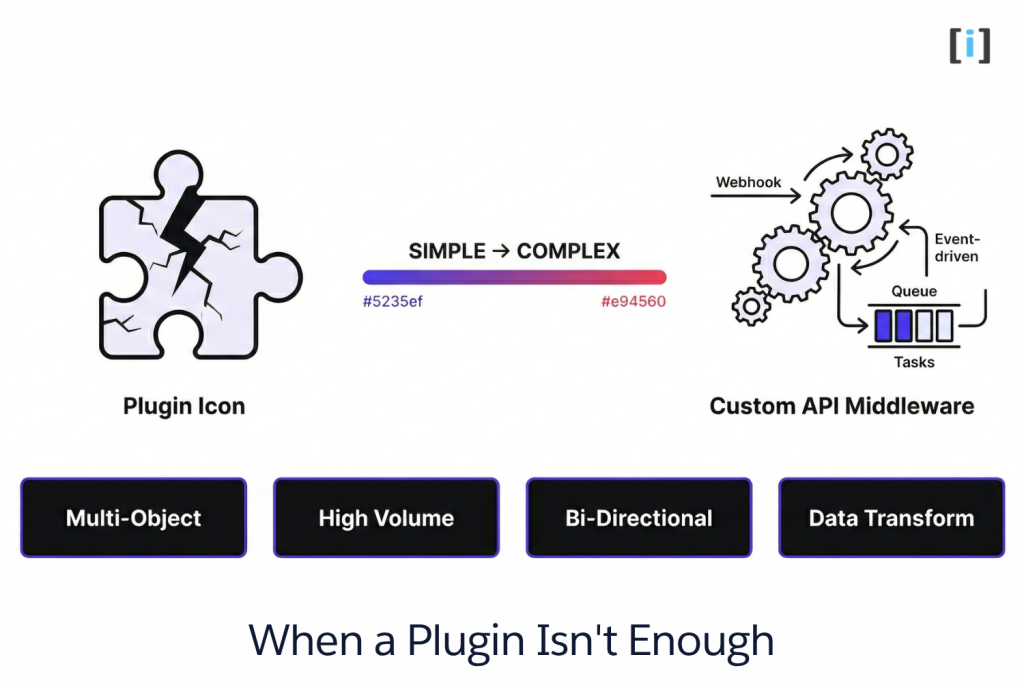
Plugins cover 80% of WordPress Salesforce integration needs. But they hit walls when your requirements get specific:
Complex multi-object workflows — If a single form submission needs to create an Account, link a Contact, open an Opportunity, and attach uploaded files in sequence, standard plugins can’t orchestrate the chained lookups.
High-volume data — Hundreds of submissions per hour during a product launch or event registration can exhaust Salesforce API limits. You need async queuing or the Bulk API.
Bi-directional real-time sync — A customer updates their address in a WordPress portal and it needs to instantly update in Salesforce (and vice versa). Most plugins that claim bi-directional sync do it on a schedule, not in real-time.
Advanced data transformation — Splitting full names, calculating totals from multi-row fields, or routing to different Record Types based on complex conditional logic.
The Litmus Test: If you’ve tried two plugins and both fell short, or if the words “custom object relationships” and “real-time” appear in the same requirement, you need custom middleware — not another plugin.
For these scenarios, custom API integration with proper error handling, retry logic, and Salesforce Composite API support is the right path. For a full breakdown of all integration methods — plugins, middleware, and custom API — see our WordPress Salesforce Integration Guide.
Need help deciding? Talk to us about your WordPress Salesforce integration — we’ll tell you honestly whether a plugin is enough or if you need something custom.
Frequently Asked Questions
Which WordPress Salesforce plugin should I use for basic lead capture?
If you’re already using Gravity Forms, the WP Gravity Forms Salesforce add-on is the most reliable option. If you’re using Contact Form 7 or WPForms, the CRM Perks CF7 Salesforce plugin supports multiple form builders and has a solid free tier. For the simplest possible setup, Salesforce’s built-in Web-to-Lead feature works without any plugin — but it’s limited to one-way Lead creation with no error tracking.
Can I sync WooCommerce orders to Salesforce?
Yes. The CRM Perks WooCommerce Salesforce plugin maps orders to Opportunities and customers to Contacts. For deeper integration with bi-directional sync and scheduled automation, miniOrange Object Data Sync (Enterprise tier) handles WooCommerce alongside form and user data in a single plugin.
Is there a free WordPress Salesforce plugin with bi-directional sync?
Object Sync for Salesforce by MinnPost is completely free and supports true bi-directional sync. It maps WordPress users, posts, and custom post types to Salesforce objects. The trade-off is a smaller community and more technical setup compared to premium alternatives.
Do these plugins work with Salesforce custom objects?
Most premium plugins (Gravity Forms Salesforce, CRM Perks, miniOrange) support mapping to custom Salesforce objects. Object Sync for Salesforce also supports custom objects in its free version. The free tiers of form plugins typically limit you to standard objects (Leads, Contacts).
How do I avoid creating duplicate records in Salesforce?
Plugins like WP Gravity Forms Salesforce and miniOrange support upsert — they check for an existing record (usually by email or External ID) before creating a new one. If a match exists, they update it instead. Web-to-Lead and basic free plugins don’t offer duplicate prevention — every submission creates a new Lead.
Will my data be secure during sync?
Reputable plugins use OAuth 2.0 authentication and HTTPS for all API communication with Salesforce. No form data passes through third-party servers (unlike Zapier-based integrations). Make sure to use plugins from established developers with regular security updates, and always test in a staging environment first.